
Let’s get one thing straight right off the bat.
You don’t need to be in shape to start working out. That’s the whole point of starting.
If you’re over 40 and haven’t seen the inside of a gym in a while — or ever — this post is written specifically for you. No judgment, no complicated programming, no equipment list that requires a second mortgage.
Just a simple, honest beginner workout routine that works for real bodies with real mileage on them.
Let’s go.
Why Working Out After 40 Is Different (But Not Harder)
Here’s something nobody tells you when you’re younger — your body changes. Muscle mass starts declining in your 30s. Recovery takes longer. Joints that never bothered you before suddenly have opinions about things.
That doesn’t mean you can’t get strong, lean, and energetic after 40. It just means you have to be smarter about it.
The biggest mistake most beginners over 40 make is copying workout routines designed for 22-year-olds. Intense daily workouts, heavy lifting from day one, zero rest days. That’s a recipe for injury, burnout, and giving up by week three.
The good news? A smarter approach actually gets better results. Here’s what that looks like.
The FueledAt40 Beginner Workout Principles
Before we get into the actual routine, here are the four principles that make this work:
1. Start slower than you think you need to Your ego will tell you to do more. Your body will thank you for doing less — at first. Building a base takes 4-6 weeks. Rushing it leads to injury.
2. Consistency beats intensity every single time Three moderate workouts per week, every week, will always beat one brutal session followed by four days of being too sore to move.
3. Recovery is part of the workout Rest days aren’t lazy days. They’re the days your muscles actually grow and repair. Honor them.
4. Progress looks different after 40 You might not see dramatic changes in the first two weeks. That’s okay. Something is happening under the surface — increased strength, better sleep, more energy. Trust the process.
The Beginner Workout Routine (3 Days Per Week)
This routine is designed for three non-consecutive days per week — something like Monday, Wednesday, and Friday. Each session should take about 45-60 minutes including warm-up and cool-down.
Warm-Up (10 minutes)
Never skip this. Your joints will not forgive you.
- 3 minutes light walking or marching in place
- 10 arm circles each direction
- 10 leg swings each side
- 10 hip circles each direction
- 30 seconds gentle torso twists
The Main Workout
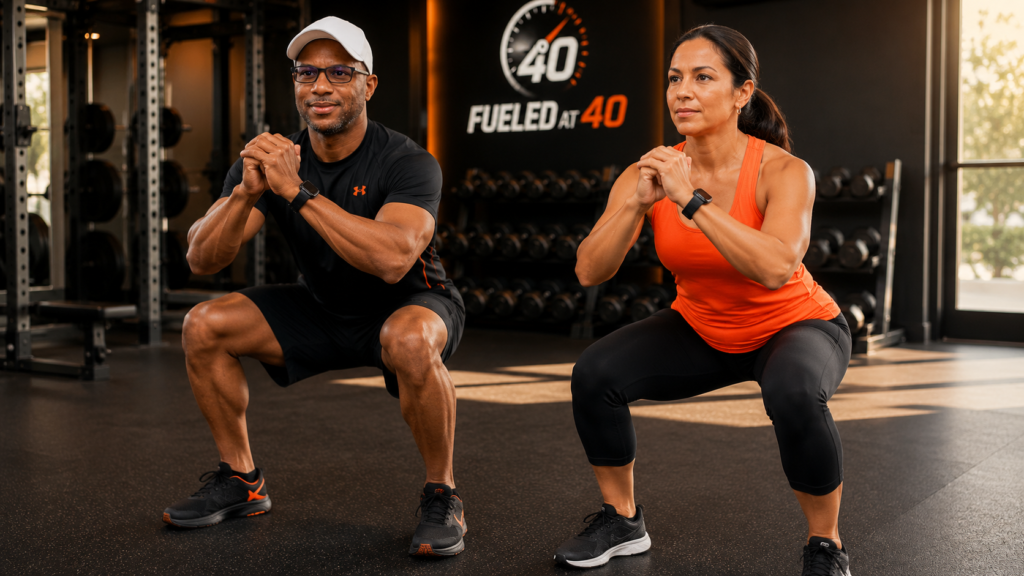
Exercise 1 — Bodyweight Squats 3 sets of 10-12 reps
Stand with feet shoulder-width apart, toes slightly pointed out. Lower yourself like you’re sitting back into a chair. Keep your chest up and knees tracking over your toes. Come back up and repeat.
This is the king of lower body exercises and it’s completely joint-friendly when done correctly. If squatting to full depth feels uncomfortable, only go as low as you can without pain.
Exercise 2 — Wall Push-Ups or Modified Push-Ups 3 sets of 10-12 reps
Not ready for floor push-ups yet? No problem. Stand an arm’s length from a wall, place your hands flat against it, and perform a push-up against the wall. As you get stronger move to an elevated surface like a bench, then eventually to the floor.
Exercise 3 — Resistance Band Rows 3 sets of 12 reps
Anchor a resistance band to a door handle or sturdy post at waist height. Hold one end in each hand, step back until there’s tension, then pull both hands toward your sides squeezing your shoulder blades together. This builds the back strength that counteracts hours of sitting.
Exercise 4 — Standing Hip Hinges 3 sets of 10 reps
Stand with feet hip-width apart and a slight bend in your knees. Hinge forward at the hips — not the waist — lowering your torso while keeping your back flat. Feel the stretch in your hamstrings then drive your hips forward to stand back up. This is the foundation of every deadlift and one of the most functional movements you can train.
Exercise 5 — Plank Hold 3 sets of 20-30 seconds
Get into a push-up position but rest on your forearms instead of your hands. Keep your body in a straight line from head to heels — no sagging hips, no raised backside. Hold and breathe. Build up to 60 seconds over time.
Exercise 6 — Standing Calf Raises 3 sets of 15 reps
Stand near a wall for balance. Rise up onto your toes as high as you can, hold for a second, then lower back down slowly. Simple, effective, and great for lower leg strength and ankle stability.
Cool-Down (10 minutes)
- 30 second quad stretch each side
- 30 second hamstring stretch each side
- 30 second chest opener stretch
- 60 seconds deep breathing
- Light walking for 2-3 minutes
How to Progress Over Time
Weeks 1-2: Focus on form, not reps. If something hurts — not burns, but actually hurts — stop and modify.
Weeks 3-4: Add one more rep to each set. Start to increase resistance band tension.
Month 2: Add a fourth exercise to each session or increase to 4 sets on your main exercises.
Month 3: Consider adding light dumbbells to squats and hip hinges.
The goal isn’t to transform overnight. The goal is to still be going three months from now.
One Last Thing
Starting is the hardest part. Not the workout itself — the starting.
You’ll talk yourself out of it a hundred times. Too tired. Too busy. Too out of shape to even begin. I know because I’ve had every single one of those conversations with myself.
But here’s what I’ve learned: the version of you that shows up for that first workout — no matter how rough it looks — is already winning. Because that version decided to start.
You’re not too old. You’re not too far gone. You’re just getting started.
Now go move.
Want more beginner-friendly workouts and real talk about fitness after 40? Join the FueledAt40 community and get it delivered straight to your inbox.