
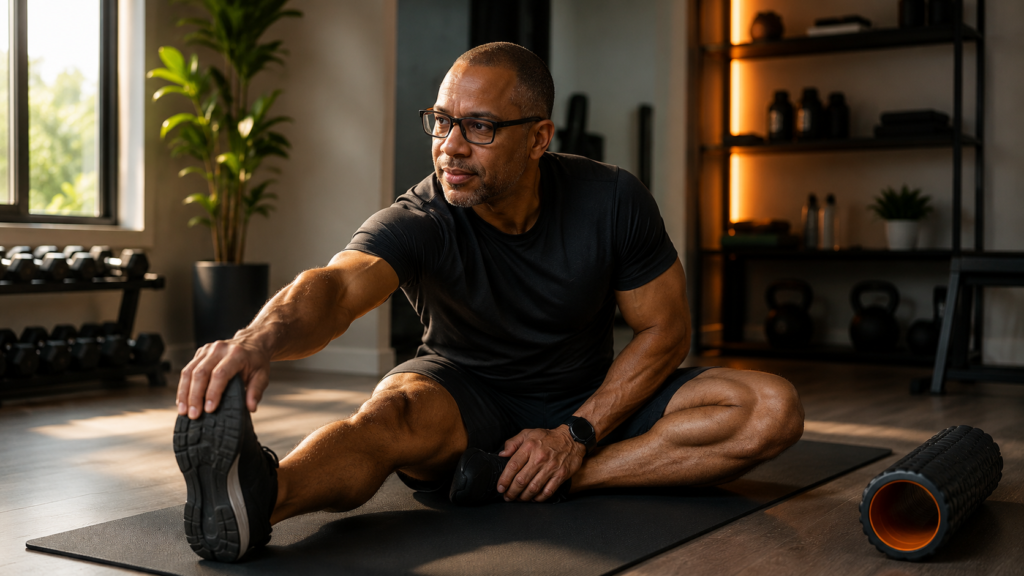
I used to think rest days were for people who weren’t trying hard enough.
In my 20s, that mindset never bit me back. I’d skip stretching, sleep five hours, hit the gym again the next morning, and feel fine. No consequences, no soreness that didn’t fade by lunch. So I never built the habit of actually recovering — I just trained, and trusted my body to handle the rest on its own.
Fast forward to now, and that same approach doesn’t just slow me down — it actively works against me.
What changed
Here’s what I’m learning the hard way: recovery isn’t the boring part you skip to get to the “real” workout. After 40, it basically is the workout. Muscle isn’t built during the lifting — it’s built during the repair process afterward. Skip that, and you’re not just risking soreness. You’re risking injury, burnout, and stalling out before you even get started.
I didn’t know any of this a few months ago. I just knew I was sore longer than I used to be, tired in a different way than I remembered, and a little discouraged that my body wasn’t bouncing back the way it used to.
Turns out, that’s not a sign something’s wrong with me. It’s a sign I need to actually treat recovery like part of the plan instead of an afterthought.
What I’m starting to do about it
I won’t pretend I’ve got a perfected system. I don’t. But here’s where I’m starting:
- Actually taking rest days. Not “I’ll see how I feel” rest days — scheduled ones, where I don’t talk myself into “just one more session.”
- Stretching before I forget my own name. Five minutes, even if it feels too simple to matter.
- Paying attention to sleep. Not optimizing it yet — just noticing when I shortchange it and how directly that shows up in how I feel at the gym the next day.
- Not treating soreness as a badge of honor. Soreness isn’t proof I worked hard. Sometimes it’s proof I didn’t recover from the last time.
Why this matters more for us than it did at 25
Our bodies don’t bounce back the way they used to — that’s just biology, not a personal failure. Connective tissue heals slower. Hormonal shifts change how we build and hold onto muscle. The margin for “I’ll just push through it” gets thinner every year.
That means the people who actually make progress after 40 aren’t the ones who train the hardest. They’re the ones who recover the smartest.
I’m not there yet. But I’m paying attention now, and that’s more than I was doing a month ago.
If you’ve been pushing through and wondering why you’re not bouncing back like you used to — you’re not broken. You just might be skipping the half of the equation that actually matters most at this stage.